
The Client Red Flags Nobody Wants to Talk About
(And How to Be a Better Partner)
There are plenty of articles out there about “client red flags.” Most of them read like a warning label for agencies: run, don’t walk.
This isn’t that.
This is about behavior, not people. Specifically, the patterns I see when well-intentioned marketing teams unintentionally create a process that wastes time, burns trust, and leads to the exact outcome they’re trying to avoid: the wrong agency, the wrong work, and a relationship that starts tense and stays tense.
At Setup, we sit in the middle of these relationships every day. We see what happens when a client sets an agency partnership up to win and what happens when they accidentally set it up to fail. So if you want better work, better chemistry, and better results, here are the most common “client behaviors” that signal trouble, plus what to do instead.
One of the reasons we built Setup is to prevent these exact dynamics, and to make agency selection more respectful and more effective for everyone involved.
Red flag #1: “RFP fodder” (aka the checkbox meeting)
What it looks like:
You already have a favorite, maybe you even have an incumbent you plan to keep. But you invite two or three more agencies “to be fair,” “to follow policy,” or “to show we looked.”
Why it’s damaging:
Agencies can smell it. Even if they show up professional, you’re asking them to spend time they’ll never get back, and you’re training your team that the process is theater.
Be a better client:
If you already have a winner, be honest and tighten the process.
If procurement requires multiple bids, tell agencies the truth about the context and the decision criteria.
Only invite additional agencies if there is a real shot to win.
A clean process beats a “perfect” process every time.
Red flag #2: Asking for spec creative before you’ve paid a dime
What it looks like:
“Bring ideas.”
“Mock up a campaign.”
“Show us concepts for our brand.”
Why it’s damaging:
Spec creative is rarely strategic. It pressures agencies to guess without access to data, stakeholders, or context. It also favors showmanship over fit, and it puts the relationship in a weird place before it begins: the agency is auditioning for free, and you’re judging them on work created in a vacuum.
Be a better client:
Ask for thinking, not free labor: approach, process, how they’d diagnose the problem, and what they’d prioritize in the first 30 days.
If you truly need a creative test, pay for it as a short, defined project.
Judge the agency on how they work, not just what they present.
The best creative comes after alignment, not before trust.
Red flag #3: Shopping agencies with no budget allocated
What it looks like:
You take meetings, you request proposals, you push timelines, but the budget is “TBD,” “pending approval,” or “we’ll figure it out after we see pricing.”
Why it’s damaging:
You’re asking agencies to architect a solution without knowing the boundaries. That usually creates one of two outcomes: wildly inflated proposals to protect against unknowns, or a lowball scope that collapses the moment reality hits.
Be a better client:
If budget is uncertain, say that upfront and share a range and decision path.
If budget truly does not exist yet, switch from “pitch” to “discovery” and limit asks to a short scoping conversation.
Protect everyone’s time by being honest about what’s real.
Agencies can work with constraints. They can’t work with mysteries.
Red flag #4: The “invisible decision maker” problem
What it looks like:
Your team runs the search. The real decision maker shows up for the final presentation, or worse, after the decision, and immediately has concerns.
Why it’s damaging:
It forces agencies to pitch to an empty room and then get judged by someone they never met. It also signals internal misalignment, which agencies interpret as a future obstacle to getting work approved.
Be a better client:
Identify the decision maker early and involve them at the right points.
Share who has input vs. who has approval.
Make sure agencies present to the people who will actually own the relationship.
No agency wants to win a “yes” that turns into a “wait, what is this?” the next day.
Red flag #5: Vague goals, fuzzy success metrics
What it looks like:
“We need a brand refresh.”
“We want more awareness.”
“Our social isn’t working.”
“We need a new website.”
Why it’s damaging:
Ambiguity doesn’t create flexibility. It creates misalignment. Without a shared definition of success, everyone interprets the work differently, and the relationship becomes a constant negotiation.
Be a better client:
Share the business reality: what is happening, what changed, what’s at risk.
Define success in plain terms: pipeline, retention, traffic quality, conversion rate, sales enablement usage, qualified leads, or whatever actually matters.
If you don’t know the metrics yet, say so and make the “measurement definition” part of phase one.
Clarity is kind. It’s also profitable.
Red flag #6: Treating the agency like a vendor, then expecting them to act like a partner
What it looks like:
No access to stakeholders. No access to data. No access to sales. Decisions made elsewhere. Feedback delivered late. Then: “Why aren’t they more proactive?”
Why it’s damaging:
Partnership requires context. If you want strategic thinking, you have to invite the agency into the reality of your business. Otherwise, you’re buying execution and hoping for magic.
Be a better client:
Give them access to the people and information they need to do great work.
Invite them to the meetings where decisions get made.
Share what’s working, what’s failing, and what you’re worried about.
If you keep them at arm’s length, you’ll get arm’s-length work.
Red flag #7: The moving target brief
What it looks like:
Scope changes every week. New “must-haves” appear midstream. Priorities shift, but timelines and expectations do not.
Why it’s damaging:
It creates churn, resentment, and missed deadlines. It also forces agencies into a defensive posture where they spend more time managing scope than solving problems.
Be a better client:
Agree on a clear scope and a change process.
If priorities change, renegotiate the timeline, budget, or both.
Protect the work by protecting the plan.
A good agency can handle change. A good client doesn’t pretend change is free.
Red flag #8: Feedback that’s subjective, inconsistent, or delivered by committee
What it looks like:
“I just don’t like it.”
“Make it pop.”
“I showed it to a few people, and they had thoughts.”
Or the classic: conflicting feedback from multiple stakeholders with equal authority.
Why it’s damaging:
Subjective feedback slows everything down and trains agencies to guess what you mean. Committee feedback often results in watered-down work that no one loves.
Be a better client:
Centralize feedback through one accountable owner.
Tie feedback to the goal and the audience, not personal preference.
Use clear language: what feels off, for whom, and why.
Great creative is rarely the result of “more opinions.”
Red flag #9: Unrealistic timelines and “rush” expectations
What it looks like:
“We need a full strategy in two weeks.”
“We need a new website in a month.”
“We need a campaign concept by Monday.”
Why it’s damaging:
Speed has a cost: quality, team burnout, or both. When everything is urgent, nothing is strategic.
Be a better client:
Ask what’s realistic and listen to the answer.
If you have a fixed deadline, be transparent about the constraints and tradeoffs.
Separate what’s urgent from what’s important.
It can be done fast. But fast is not the same as good.
Red flag #10: Paying late, squeezing terms, or treating finance like someone else’s problem
What it looks like:
Invoices sit for 60 to 90 days. SOWs take forever. Procurement adds hoops after the work begins. You’re asking for partnership while acting like the agency’s cash flow is their issue.
Why it’s damaging:
It erodes trust and forces agencies to protect themselves. It also makes you less attractive to the best partners, because the best partners have options.
Be a better client:
Pay on time.
Finalize contracts quickly.
If bureaucracy exists, acknowledge it and manage it.
Nothing says “we respect you” like honoring the basics.
A simple way to sanity-check your process
If you want a quick gut-check, ask yourself:
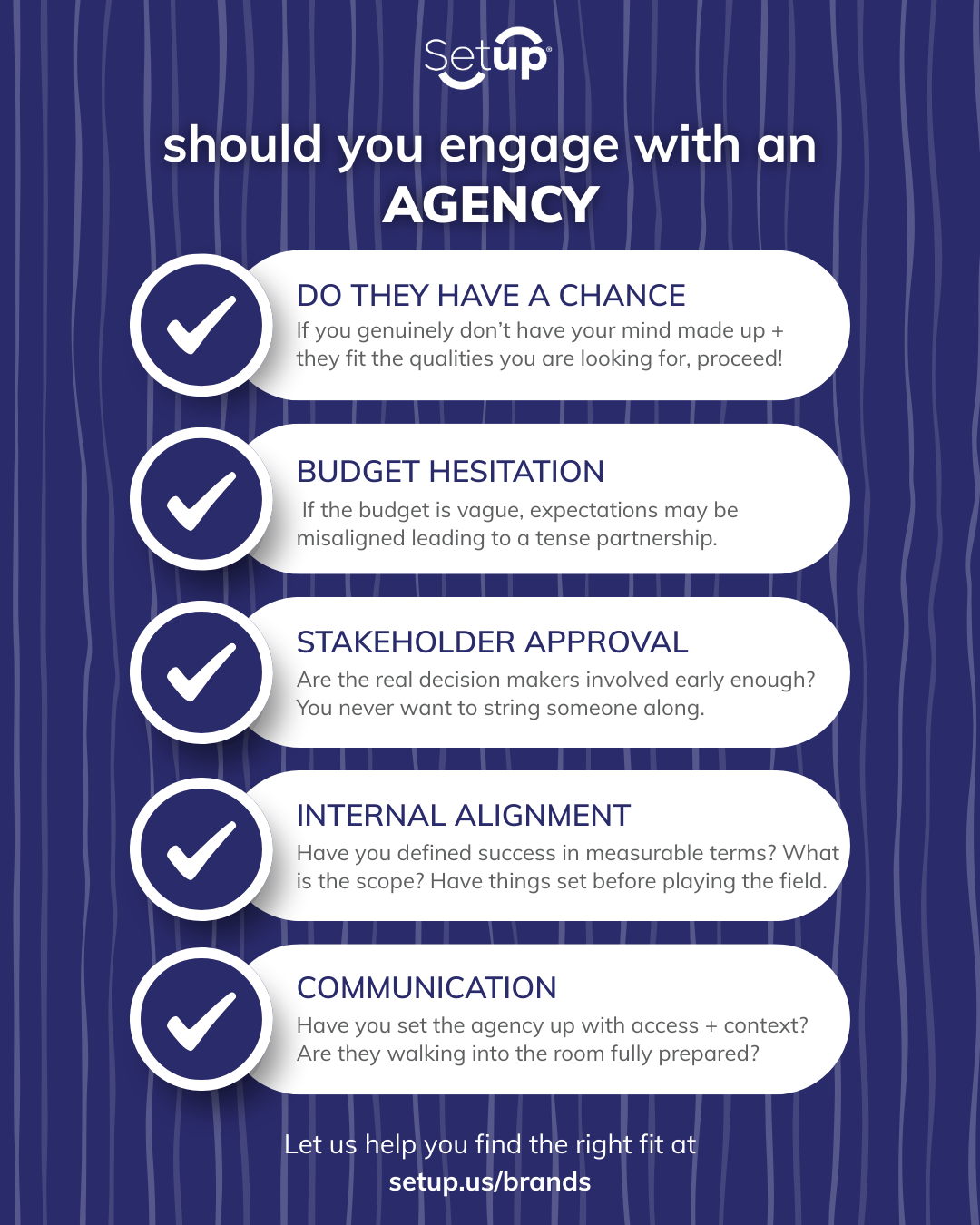
Does every agency we meet have a real chance to win?
Have we shared a clear budget range and decision path?
Are the real decision makers involved early enough?
Have we defined success in measurable terms?
Have we set the agency up with access and context?
If you can’t confidently answer yes to most of those, the process is at risk, even if the intention is good.
The point of this isn’t guilt. It’s leverage.
Most client-side “red flags” aren’t malicious. They’re symptoms of internal misalignment, procurement pressure, unclear priorities, or simply a process that hasn’t been updated since the last time you ran it.
But here’s the truth: the agency relationship doesn’t start when the contract is signed. It starts with how you behave during the search. That’s when trust gets built, or quietly lost.
If you want an agency that brings their best, treat the beginning like it matters. Because it does.
If you want, I can turn this into a version tailored to a specific audience (CMOs, marketing directors, procurement-led orgs, or startups), and add a short checklist you can use before you ever schedule the first agency call.
Want to run an agency search without wasting time (yours or theirs)?
That’s exactly what we do at Setup.
We help marketing leaders clarify what they actually need, align internal stakeholders, and then meet only agencies that are a legitimate fit, culturally and capability-wise. No checkbox meetings. No performative pitches. No guessing games on budget or decision-making.
Here’s how Setup helps you avoid these red flags and land the right partner:
Sharper definition of the need
We translate “we need help” into a clear scope, success metrics, and non-negotiables, so agencies can respond with substance.Internal alignment before you ever take a meeting
We help you pressure-test stakeholders, decision rights, timeline, and budget guardrails so the process doesn’t blow up in week three.A curated agency shortlist built for your situation
You meet a small number of qualified agencies that match your goals, category realities, team structure, and working style.A cleaner, more respectful evaluation process
We help structure the steps so you can compare agencies fairly, keep momentum, and make a confident decision.
If you’re planning an agency search (or you’re unsure whether your current agency is the right fit), Setup can help you get to the right answer faster, with less friction.
The best agency relationships don’t start with a flashy pitch. They start with clarity, respect, and a process that enables both sides to win. If you want an agency partner who will bring their best, set the table the right way.













Setup CEO + Founder, Joe Koufman, sat down with Meredith Winczewski, the Chief Marketing Officer for Honeywell, to talk about authentic leadership, the value of listening, why marketers should not be afraid of lateral career moves, the importance of digging into data, and how AI is helping make complex marketing work more efficient.