The Real Reason Brands Break Up With Agencies (It’s Not Budget)
Relationships don’t end because of one bad meeting. Have you ever heard of the phrase, “Trust is earned in drops and lost in buckets”"?”
Relationships end because of the same small issues happening again and again until the trust runs out. And if you’ve ever been blindsided by a brand-agency breakup (from either side), you’re not alone. The 2025 Marketing Relationship Survey by Setup and in partnership with the CMO Institute shows something that’s both surprising and painfully familiar:
Brands aren’t racing to leave… but they’re also not thrilled.
In other words: the relationship might still be “together,” but it’s not exactly thriving. So what’s really causing breakups right now?
Brands say the relationship gap is actually a delivery gap…
Each year, Setup’s Marketing Relationship Survey gives us a clearer look at what’s working, what’s breaking, and where brands and agencies are misunderstanding each other. And this year’s story is loud: Clients want better delivery, better value, and to feel understood.
That’s the real heartbreak. Not the contract. Not the pitch. Not the onboarding.
It’s the moment a brand realizes:
“We’re paying a lot.”
“We’re doing a lot of work to manage this relationship.”
“And somehow… it’s still not working.”
Why Brands Actually End Agency Relationships + What Agencies Think
When we asked client-side marketers what caused them to end relationships in 2025, their answers were:
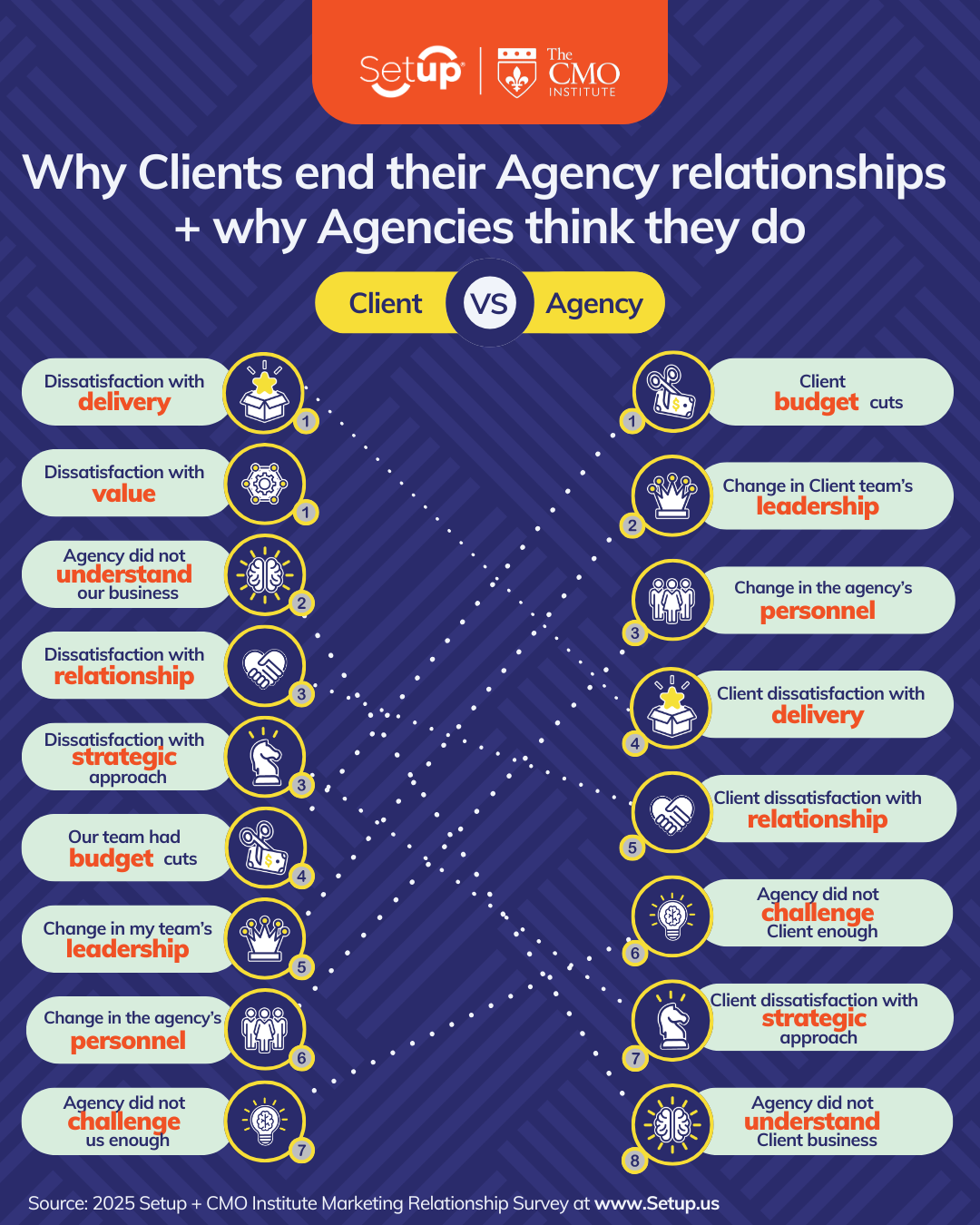
Dissatisfaction with delivery (61.11%)
Dissatisfaction with value (61.11%)
Agency did not understand our business (44.44%)
Dissatisfaction with relationship (410.74%)
Dissatisfaction with strategic approach (410.74%)
Brands aren’t saying, “We broke up because we weren’t challenged enough…”
They’re saying: “We broke up because the relationship didn’t deliver what it promised.”
Agencies have a different story about why relationships end, hence the disconnect.
Agencies believe clients end relationships because of:
Client budget cuts (75%)
Change in client leadership (55%)
And while these two factors can certainly play into a relationship ending, they aren’t the full truth because brands are still telling us the deeper reason is: “The work didn’t feel worth it.”
Most breakups don’t happen because of one catastrophic failure.
They happen because:
timelines slip and no one owns it
strategy gets watered down
communication becomes reactive
the agency stops feeling like a true extension of the team
the brand starts questioning if the value matches the cost
Relationships break over time because of repeated mistakes that were not acknowledged.
The 3 “silent killers” behind most breakups
Avoidant partners can exist in all types of relationships, even in business. If you’re a brand, these are the reasons you start pulling away. If you’re an agency, these are the reasons your client stops replying as quickly.
1. Delivery becomes inconsistent
Delivery dissatisfaction is the #1 breakup driver.
This often looks like:
missed deadlines
unclear ownership
rushed deliverables
“we’re still working on it” cycles
deliverables that don’t match the original expectations
2. Value becomes unclear
Value dissatisfaction rose sharply in 2025 and value isn’t just “results.”
Value is also:
clarity
proactivity
strategic thinking
helping the brand feel confident in decisions
making the brand’s job easier
3. The brand doesn’t feel understood
Brands end relationships when they feel like the agency doesn’t understand their business.
This shows up as:
strategies that don’t fit internal reality
messaging that misses the brand voice
recommendations that ignore team constraints
campaigns that look good but don’t solve the real problem
So… is it budget? Or is budget the excuse?
Sometimes a budget cut is truly unavoidable, but, often, budget becomes the cleanest “reason” to end something that already wasn’t working.
How to prevent the breakup (before it’s too late)
If you want to keep relationships healthy, you need relationship maintenance and performance reviews.
Here are 5 things that prevent breakups on both sides:
1. Monthly “value recap” check-ins - This is more than a status update. This is a chance to connect to showcase results.
2. Clear expectations + delivery agreements - The best partnerships don’t rely on assumptions, but regularly communicate updates and changes. Some agencies in the survey report said they did not have designated account people. This is a must for seamless delivery. And on the client side, clients need to be open about making their agency a part of their team.
3. Proactive problem-solving - If you’re an agency, don’t always wait for the client to ask. If you’re a client, know that you hired an expert and allow them to advise you.
4. Business understanding rituals - If the brand evolves, the agency must evolve with it.
5. Feedback loops that feel safe - Brands need space to say what’s not working without fear of defensiveness. Communication needs to be open on both sides to have progress.
The good news is that brands are staying, showing that they are not eager to leave and are willing to work through the difficulties. The agencies that win in 2026 will be the ones that treat delivery, value, and understanding as non-negotiables.
Want help fixing the relationship before it breaks?
Setup helps brands and agencies build partnerships that actually work with clarity, structure, and trust.
If you’re a brand evaluating your agency relationship, or an agency trying to strengthen retention and delivery systems, we’d love to help.

The annual Setup Marketing Relationship Survey reveals a growing disconnect between what clients say ends agency relationships (delivery + value) and what agencies think ends them (budget cuts + leadership changes). If you want stronger partnerships and better outcomes in 2026, this report highlights exactly where relationships break and how to fix them.
Over the past year, we’ve watched the following patterns emerge across seemingly unrelated sectors: rising consumer expectations, demand for authenticity, growing complexity, and the tension between automation and human connection.
We interviewed multiple marketers from an array of industries in our blogs below, and we discovered consistent trends across the board. Check out all of our industry blogs throughout 2025 from leaders at Blackbaud, Hiscox USA, Mimedx, MONPURE, Kimberly-Clark Professional, and more.
A call for marketers and agencies to participate in the 2025 Marketing Relationship Survey, before it’s too late.
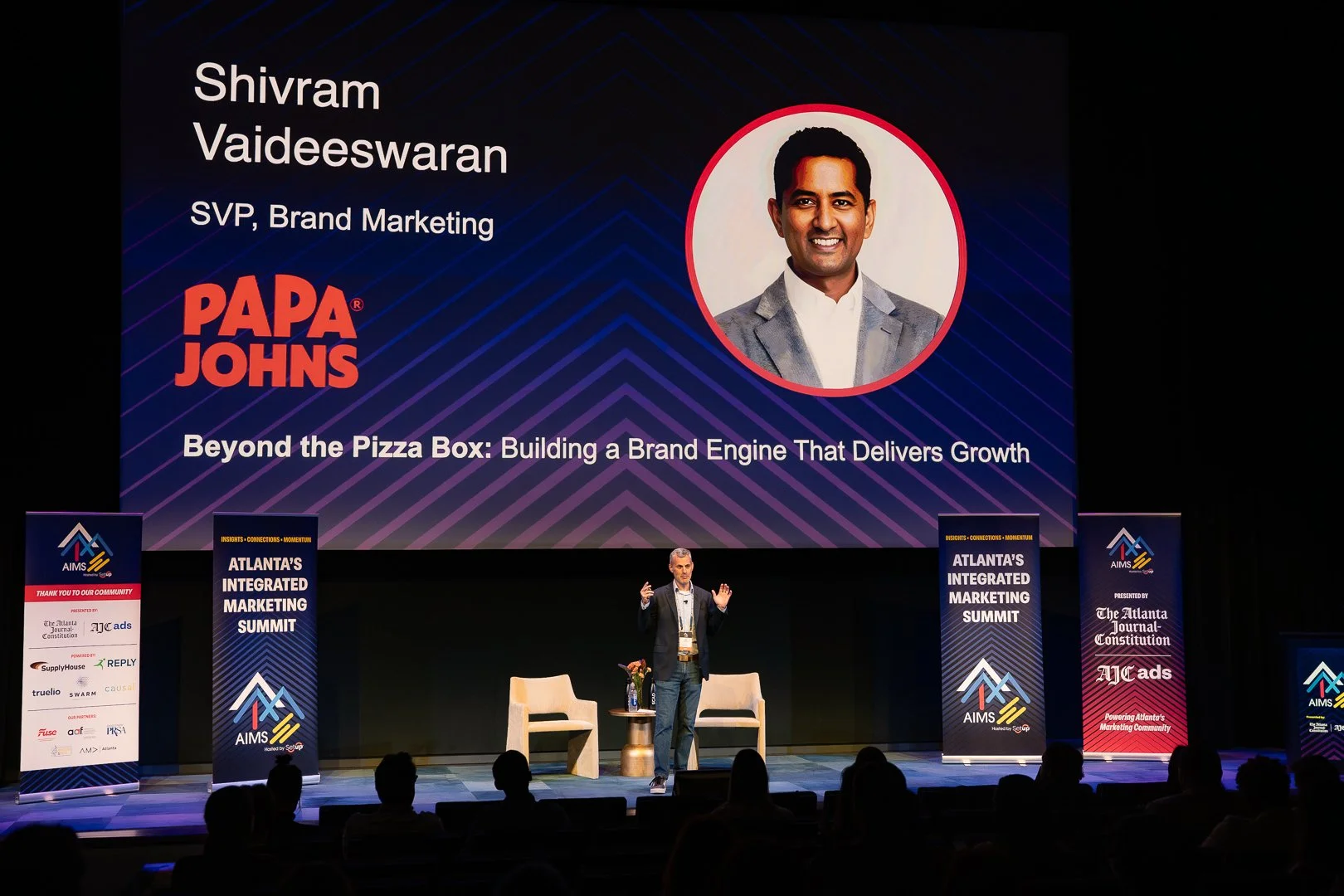
On November 19, 2025, Atlanta’s vibrant marketing community united under one roof for the first-ever Atlanta Integrated Marketing Summit (AIMS) — a remarkable experience that turned inspiration into action, focused on meaningful connections, and highlighted incredible leaders from UPS, Kellanova, Edible Brands, and Papa Johns who are actively pushing the industry forward.
Explore the denim duel between AE’s Sydney Sweeney campaign and Gap’s Milkshake-fueled comeback—and what marketers can learn.
Most agency searches begin with urgency: a priority shift, a launch date appears, and suddenly, you’re writing an RFP at midnight. In that scramble, you invite too many firms, ask the wrong questions, and end up choosing based on pitch theater instead of day-to-day fit. The fix isn’t a better RFP template. It’s time - specifically, the time you spend getting to know agencies before you need one.
Marketers are grappling with how to make their strategy feel more impactful and human in 2025, but in the nonprofit world, that challenge comes with the added pressure of limited budgets and expansive missions. For Lynn Godfrey, Chief Experience Officer at Blood Cancer United, the solution lies in staying intentional, deeply segmenting audiences, and adapting quickly in a constantly evolving landscape.
Private wealth marketing is built on personal relationships, which can make the advancements in technology more and more challenging. In an industry where discretion and relationships reign supreme, marketers must learn how to integrate data, automation, and innovation without losing trust.
To explore this balance, we spoke with Cathy McLagan, Managing Director of Growth Enablement at CIBC Private Wealth US.
“Data-driven” marketing is about proactively leveraging insights to make strategic decisions. But what defines a truly data-driven media approach?
If your media strategy feels tangled and unclear, you’re not alone. Here’s how smart brands are simplifying the chaos and getting real results.
Whether you’re managing campaigns for a national brand, a franchise QSR, or a B2B tech company, the challenge is the same: how do you build smarter media strategies that actually tie back to real business outcomes? We spoke with top experts from Sagepath, Goodway Group, and Look Listen to dig into what’s working, what’s changing, and where media performance and analytics are headed next.
Retail marketing is entering a new era where value, trust, and operational excellence matter more than volume, visibility, and trend-chasing. As shopper expectations evolve, smart retail marketers are embracing personalization, AI, and brand positioning that aligns with customer values. We spoke with Kaylin Staub, the Chief Marketing Officer at SupplyHouse, and a leader we believe to be leading the pack in these efforts. Check out her interview.
In the midst of change and new tech, Marti Walsh, VP of Customer Experience and Marketing at Kimberly-Clark Professional, brings us back to what really matters: showing up with purpose. In this conversation with Setup, she shares how her team builds trust through consistent omnichannel messaging, thoughtful use of AI, and a commitment to authenticity that connects with real people.
Media is about delivering results that are meaningful. Your strategy should be about more than impressions. But with siloed data and rising expectations, it's hard to prioritize meaning under pressure to perform.
That’s why we’ve brought together three powerful blogs filled with insights from industry experts at the top of their media game to help you rethink your media planning, simplify execution, and activate smarter strategies that drive growth.
“Data-driven” marketing is about proactively leveraging insights to make strategic decisions. But what defines a truly data-driven media approach?
Creating a marketing budget isn’t just a financial exercise; it’s a strategic act. It’s your roadmap for growth, your guardrail against wasted effort, and, when done well, your strongest case for internal alignment and external results.
But while most marketers know how much they wish they could spend, far fewer know how much they should. So, where do you begin?
Marketers today juggle numerous platforms, overwhelming data, and competing internal demands, creating a complex media landscape that clouds performance clarity. What drives this complexity, and how can brands effectively navigate it?
Today’s marketers face immense pressure to justify media spend and measure tangible impact. But fragmented data, inadequate tracking, and unclear KPIs often cloud visibility. How can brands build smarter strategies that truly connect media spend to real business outcomes?
At Setup, we don’t just listen, we track patterns, analyze them, and come up with solutions to assist marketers with their challenges. Every year, our Marketing Relationship Survey gathers insights from brand and agency marketers to identify the core challenges, shifts, and opportunities in the client–agency relationship. These aren’t hypotheticals; they’re real-time questions marketing leaders are actively asking. And your answers help drive the industry's evolution.
Every few years, we revisit the Health and Wellness space to track major shifts. Since the pandemic, the industry has made significant strides to meet evolving consumer demands and expectations.
We spoke with Mark Yosick, Senior Marketing Director, Surgical at MIMEDX, about his experience in the space, the challenges he’s faced, and the trends he sees shaping the future.
In the last five years, the health and wellness industry has experienced a significant transformation, from personalized nutrition, to the rise of telehealth, to a growing emphasis on marketing transparency. The consumer is becoming more integral in everyday decisions across all industries.
What has changed and what is continuing to take priority in today’s health and wellness sector?
When it comes to purchasing, today’s consumers want more than just a product–they want something to believe in. The rise of purpose-driven brands, founder visibility, AI-powered personalization (with boundaries), and culturally rooted storytelling are reshaping how beverage companies connect with their audiences.
BLK & Bold, a coffee brand built on community, culture, and impact, is a leader in this movement. In this exclusive interview with Co-Founder Rod Johnson, Johnson shares how they’re redefining what it means to market in the beverage space.
In a conversation with Nate Bigger, Founder + CEO of MONPURE and the leader behind the brand’s marketing strategy, we heard firsthand how the company is navigating the beauty landscape with authenticity, science-led storytelling, and a deep understanding of the emotional side of self-care.
The financial services industry has never been known for moving fast—but in 2025, the pressure is on. With artificial intelligence (AI) redefining customer engagement, fintech innovations raising consumer expectations, and tighter regulations around data privacy, marketing leaders in finance are rethinking how they show up, connect, and grow.
With agentic AI systems driving automation, fintech innovations setting new standards, and post-pandemic digital acceleration cementing permanent shifts in behavior, the financial marketing landscape is evolving at a rapid speed. So, how can financial brands stay ahead?
Is AI stripping consumers of excitement? Is there unconscious bias in AI? How can marketers stand out while using the same tech stack?
In conversations with marketing leaders in the high-tech and innovation sector, adopting AI is not the challenge. The future belongs to teams who adapt to AI while investing in human elements like curiosity, connection, and inspiration.
Advancements in AI over the last few years have shifted customer expectations. With all of this power and access, however, comes more responsibility on marketers to lead with intention and care. Explore the biggest shifts in High-tech + Innovation and how marketing leaders can act accordingly.
When it comes to picking an agency, chemistry between brands and agencies is often overlooked in the selection process, but it’s one of the biggest indicators of long-term success. Yes, you need a business partner with the right capabilities and experience, but when it comes down to the final candidates, chemistry is what truly sets long-term partners apart.
The path to growth for marketing Agencies in 2025 is no longer about simply acquiring new Clients; it’s about scaling effectively. With evolving Client demands, technological advancements, and increasing competition, Agencies must focus on strategies that enable sustainable and efficient expansion.
Based on insights from Setup’s research, expert advice, and industry trends over the last 10 years, here are five key strategies to help Agencies scale effectively in 2025.
And if you’ve ever been blindsided by a brand-agency breakup (from either side), you’re not alone. The 2025 Marketing Relationship Survey shows something that’s both surprising and painfully familiar:
Brands aren’t racing to leave… but they’re also not thrilled.