
Why Do Clients End Agency Relationships? 8 Years of Surveys Point to a Clear Pattern
Setup is conducting our Marketing Relationship Survey for the 8th year to better understand what is happening between brands and agencies, and where there is a disconnect for opportunities to blossom.
For the second year in a row, we are partnering with The CMO Institute to gather perspectives from brand and agency professionals and identify the gaps that can prevent stronger collaboration. That long-term view matters because there are patterns that can be avoided that truly come from communication and expectation mishaps.
A single year can tell us what marketers are feeling right now. Looking across years helps us see which problems are temporary—and which ones keep resurfacing.
For this first look back at the Marketing Relationship Survey, we are focusing on one question:
Why do clients end agency relationships?
The answer has changed over time, but the data points to a larger theme: clients rarely leave simply because of circumstances outside an agency’s control. Increasingly, they are pointing to the experience of working with the agency itself—its strategy, delivery, value, understanding of the business, and strength of the relationship. All issues that, if communicated properly, could be addressed.
Which traces back to one of Setup’s main philosophies: chemistry matters.
Why We Keep Asking
Setup first launched the Marketing Relationship Survey because reliable information about the agency-client relationship was difficult to find. In 2018, Setup noted that brands were unlikely to independently study these issues, while agencies could only gather feedback from the clients they already served. Sitting between both groups gave Setup an opportunity to hear from each side and identify where their perceptions differed.
That ability to compare perspectives remains one of the most valuable parts of the research.
Agencies understandably have their own explanation for why business is lost. Clients often have another.
And sometimes the gap between those two answers is substantial.
2020: Agencies Blamed Budgets More Than Clients Did
One of the earliest clear disconnects appeared in the 2019–2020 survey.
75% of agencies believed budget cuts were the number-one reason client relationships ended. Only 24% of clients said budget cuts were actually responsible.
That gap introduced a question that has continued to surface in later surveys:
Are agencies correctly diagnosing why clients leave?
Budget changes are real. Leadership changes are real. Internal restructuring is real.
But when an agency assumes every lost relationship resulted from an external factor, they may miss an opportunity to understand what they could have done differently internally.
That distinction becomes increasingly important as we move through the following years.
2021: Brands Were Already Willing to Reevaluate
The 2021 survey did not report the same detailed ranking of reasons clients had ended relationships, so we cannot make a direct year-over-year comparison on that specific question.
What it did show was a market becoming increasingly comfortable with reassessing agency relationships.
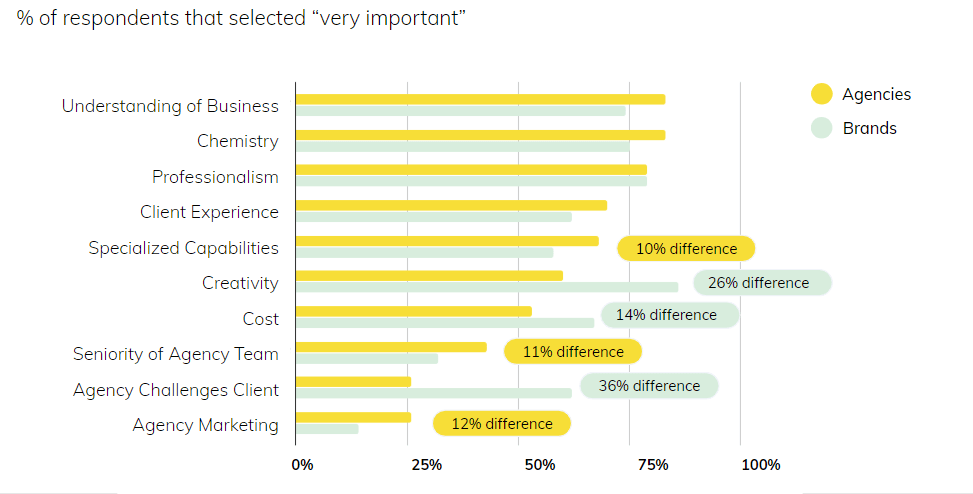
30% of brand marketers said they were likely or somewhat likely to switch agencies in the next six months. Brands also said they wanted agencies to better understand their businesses and provide greater transparency and communication.
The message was becoming clearer: simply producing work was not enough. Clients wanted agencies that understood the organization behind the marketing.
2022: Strategy Became the Breaking Point
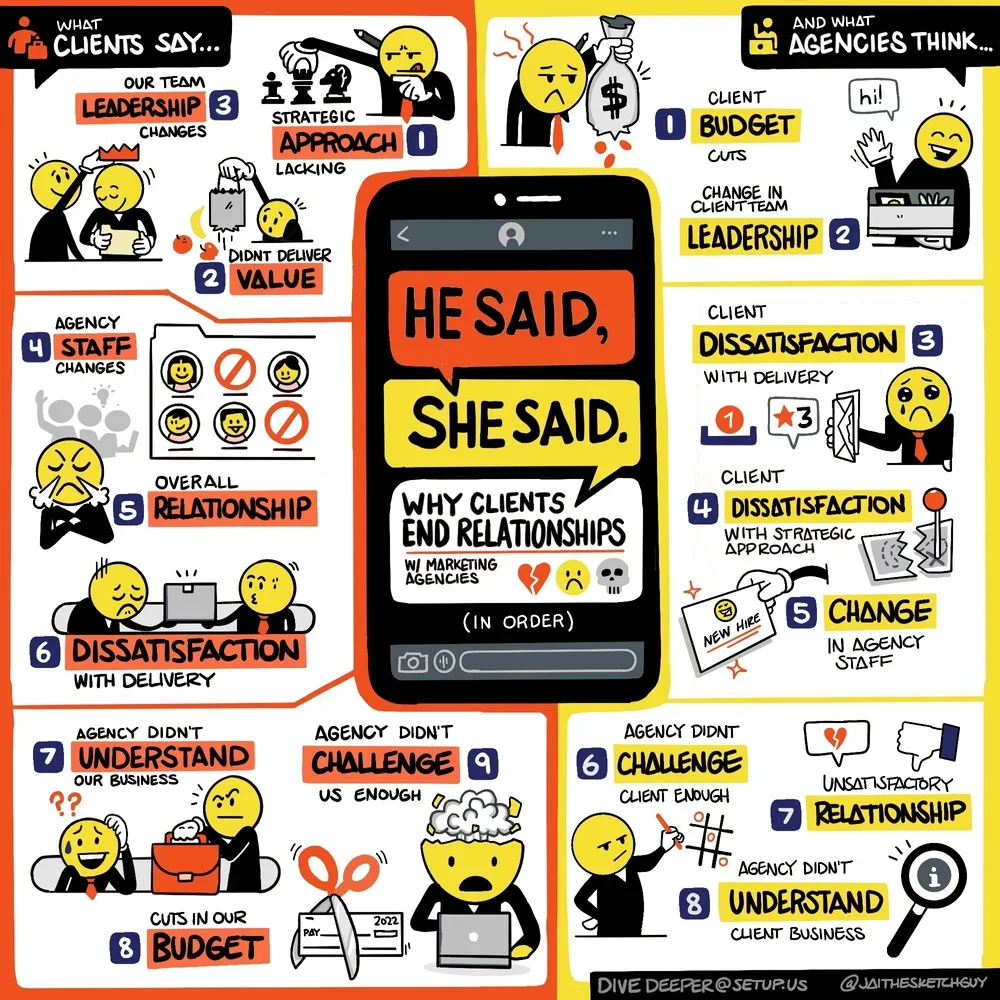
By 2022, Setup was measuring the reasons for agency breakups more directly again, and the results were striking.
Dissatisfaction with an agency's strategic approach became the number-one reason clients said they ended relationships.
Meanwhile, agencies still believed client budget cuts were the most common cause. Clients ranked budget cuts as the eighth reason.
The survey also surfaced growing frustration with agency team turnover. Changes in account personnel could force clients to continually reeducate new team members, disrupt consistency, and weaken institutional knowledge.
Taken together, the 2022 results painted a picture of clients asking agencies to provide more than execution.
They wanted partners that were:
Strategic
Consistent
Collaborative
Transparent
Knowledgeable about their businesses
Able to demonstrate value
When agencies did not deliver those things, clients were increasingly prepared to look elsewhere.
2023: Value Overtook Strategy
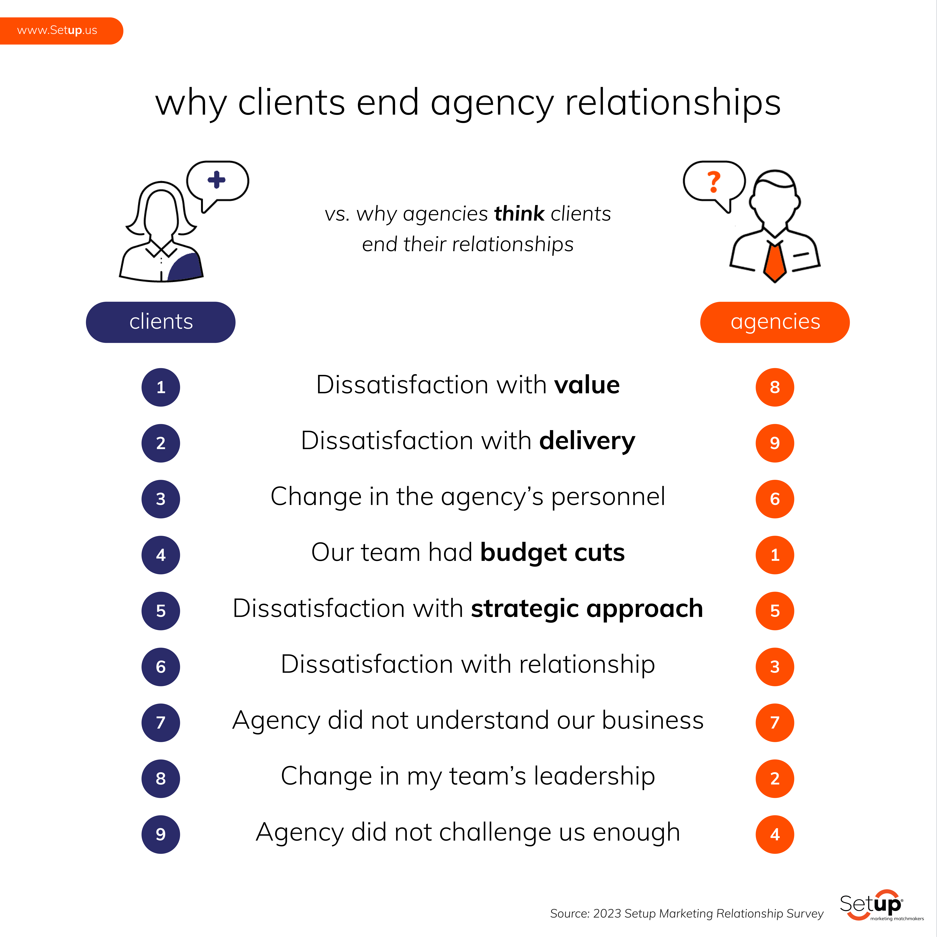
Then the priority for clients shifted the following year. In 2023, dissatisfaction with value became the number-one reason clients ended an agency relationship, rising from 39% in 2022 to 53% in 2023.
At the same time, dissatisfaction with strategic approach fell from 43% to 30%, moving from the number-one reason in 2022 to number five in 2023.
That does not necessarily mean strategy suddenly stopped mattering… it possibly suggests that agencies may have been improving strategically while another question for brands became more urgent:
Is what we are getting worth what we are paying?
Delivery also emerged as a major issue. Clients ranked dissatisfaction with delivery as their second-most-common reason for ending a relationship, while agencies ranked delivery ninth.
That disconnect is significant because clients were telling agencies that the work itself and the ability to deliver it was consistently threatening relationships, and many agencies did not seem to appear to recognize the severity of the problem.
2024: Delivery Moves to Number One
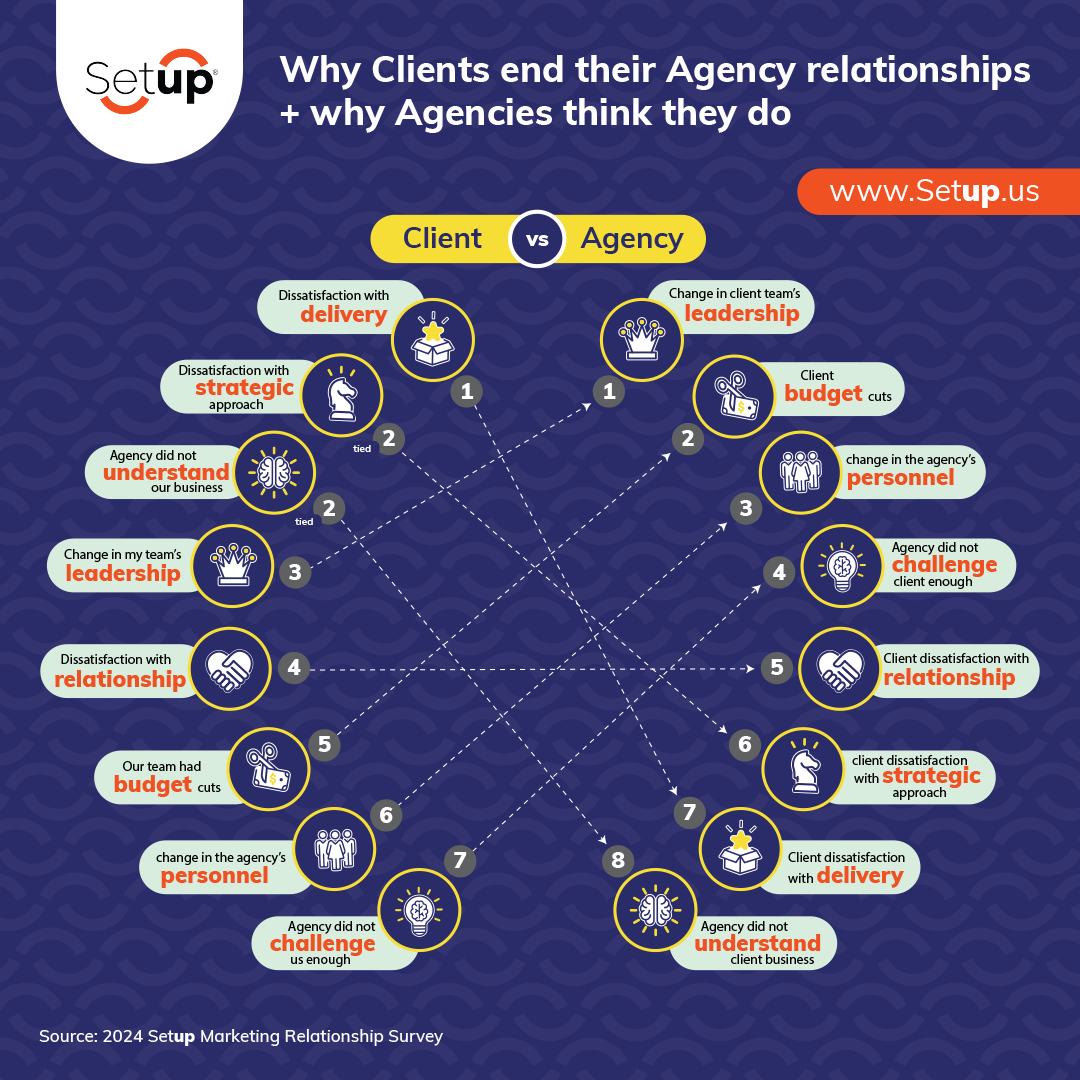
By 2024, the delivery issue became even harder to ignore. 48% of clients cited delivery issues as the number-one reason they fired an agency.
MediaPost's coverage of Setup's study noted that dissatisfaction with delivery had increased 14 percentage points from the previous year. At the same time, fewer clients said they planned to switch agencies—40%, down from 55% in 2023—but 68% still planned to review their agency relationships by the end of the year.
A client does not have to be actively firing an agency to be evaluating whether the relationship still works. Agency reviews can be signals that clients are asking harder questions about performance, alignment, and whether their current partners are still suited to where the business is headed. And increasingly, delivery was at the center of those questions.
2025: Delivery and Value Become Equally Urgent
The 2025 results reinforced the trajectory.
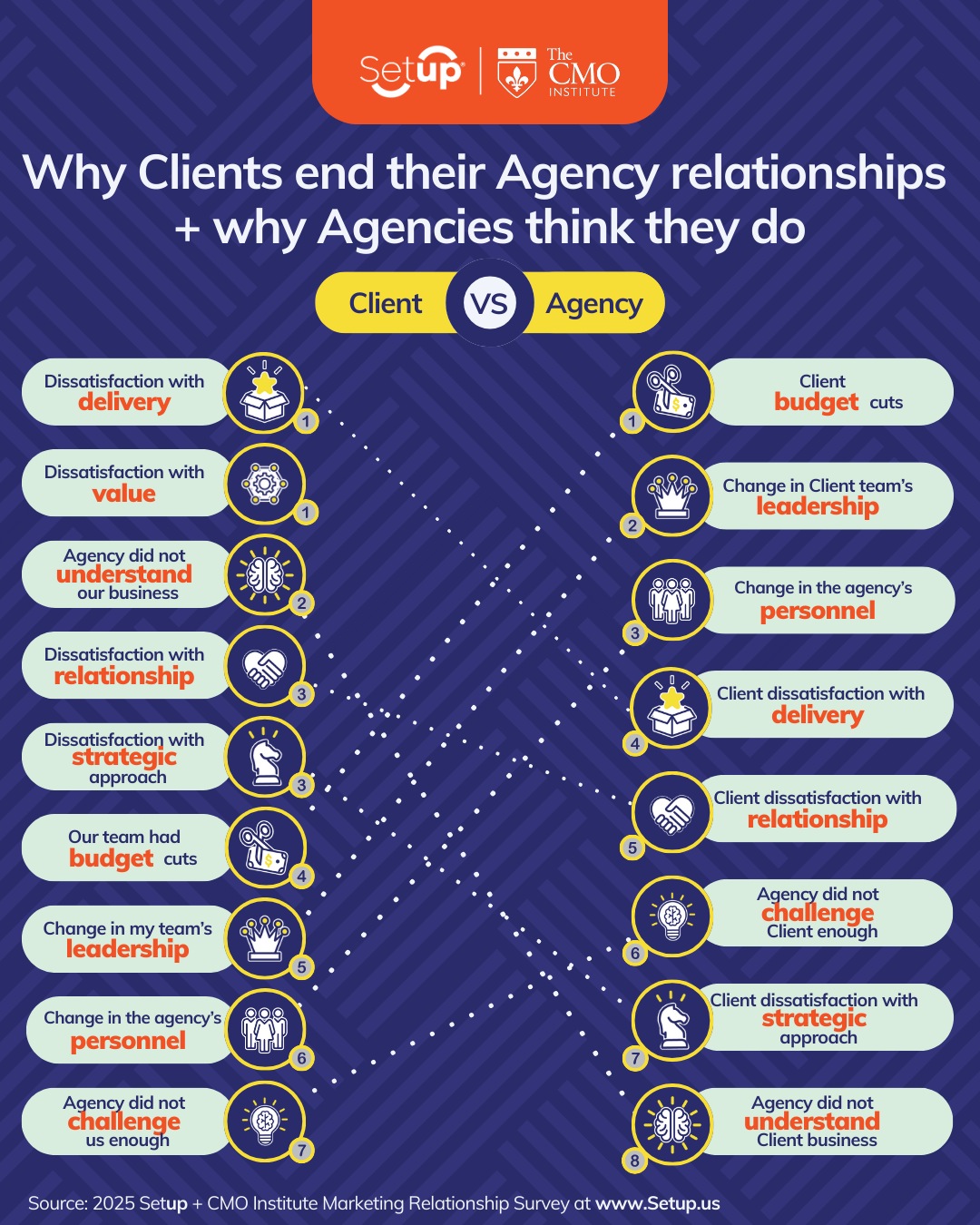
The top reasons clients reported ending agency relationships were:
Dissatisfaction with delivery — 61%
Dissatisfaction with value — 61%
Agency did not understand our business — 44%
Dissatisfaction with the relationship — 41%
Dissatisfaction with strategic approach — 41%
Budget cuts — 39%
Change in client leadership — 35%
Change in agency personnel — 28%
Perhaps most revealing was the agency-side response.
75% of agencies still believed client budget cuts were the leading cause of relationships ending – holding on to a reason that was not supported at all. Only 18% identified dissatisfaction with delivery, and just 3% pointed to a lack of understanding of the client's business.
Eight years into studying these relationships, that perception gap remains one of the most important findings. Clients are largely pointing inward at the partnership like how the work did not deliver, the value was not clear, and they do not feel understood.
Agencies are more likely to point outward at the budget and leadership changing.
Sometimes the agency is right, but the survey suggests that stopping at that explanation can leave important lessons unexplored.
The Reasons Change. The Underlying Expectation Does Not.
Looking across the years where Setup measured this question, the number-one issue has moved:
2022: Strategic approach
2023: Value
2024: Delivery
2025: Delivery + value
On the surface, those look like different problems, but they are closely connected.
A strong strategic idea that cannot be executed creates a delivery problem.
Strong delivery that costs more than the client believes it is worth becomes a value problem.
Work that technically meets the brief but fails to account for the client's business becomes an understanding problem.
And when those issues are allowed to compound without honest communication, they eventually become a relationship problem.
That is why the Marketing Relationship Survey matters.
It gives brands and agencies an opportunity to see not only what each side thinks, but where those perceptions fail to line up.
Relationships Usually Don't Break Overnight
Clients generally do not leave because of one bad meeting or one disappointing deliverable. Relationships deteriorate when missed expectations accumulate, value becomes harder to explain, communication turns reactive, and the agency stops feeling like a true extension of the client's team.
That is encouraging in one sense because many of these problems are addressable.
Agencies can ask whether they are:
Delivering consistently against expectations
Demonstrating the business value of their work
Understanding the client's organization, not simply its marketing brief
Communicating issues before they become surprises
Bringing proactive strategic thinking
Making sure the right talent stays close to the account
And clients have responsibilities too. Strong partnerships require clear expectations, useful feedback, transparency, access to the right information, and a willingness to communicate when something is no longer working.
The point of the survey is to make the invisible parts of these relationships easier to see and not to point fingers.
What Will Clients Say in 2026?
For the eighth year, Setup is once again asking marketers on both sides of the relationship to tell us what is working, what is changing, and where the gaps remain. This year's survey, conducted in partnership with The CMO Institute, will examine why clients end partnerships alongside broader questions around agency expectations, marketing challenges, AI, and the future of brand-agency collaboration.
Will delivery remain the biggest concern?
Will value become even more important as marketing budgets face greater scrutiny?
Will AI change what brands expect agencies to deliver?
Or will an entirely new pressure emerge?
We will find out when the 2026 results come in.
Take the 2026 Marketing Relationship Survey today to help shape the next chapter of the brand-agency relationship.