
What Kinds of Agency Services Are Clients Hiring?
Eight Years of Setup’s Marketing Relationship Survey Showcases How Priorities Shift
Setup is conducting its Marketing Relationship Survey for the eighth year to understand how brands and agencies are working together, where relationships are changing, and what marketers need most from their partners.
This year, Setup is partnering with The CMO Institute to gather perspectives from brand and agency professionals across the industry to explore the types of agency services brands need most.
The services brands hire agencies for offer a window into what marketing teams cannot—or do not want to—handle alone. They show us where internal teams need added expertise, where priorities are shifting, and where agencies may have the greatest opportunity to provide meaningful value.
Several years of Marketing Relationship Survey results show just how quickly those priorities can shift. Content surges. PR falls. Social rises. Website work comes roaring back. CRM becomes more important. Specialized needs that once sat near the bottom start gaining ground.
There is no permanent list of “hot” agency services because the needs move with the market.
Why Setup Keeps Asking
When Setup launched the Marketing Relationship Survey in 2018, the goal was to fill a gap in available research about the relationship between brands and agencies. Brands rarely study these relationships across the broader industry, and individual agencies generally only know what their own clients tell them. Setup’s position between the two groups creates an opportunity to see the relationship from both sides.
Eight years later, that long-term view allows us to ask a different question: How has the work brands rely on outside partners for changed over time?
Not every year asked this question in exactly the same way, so the data should not be treated as a perfect year-over-year measurement. In some years, Setup tracked overall marketing spend; in others, the survey asked more directly which agency services clients were using.
But the broader shifts are still telling.
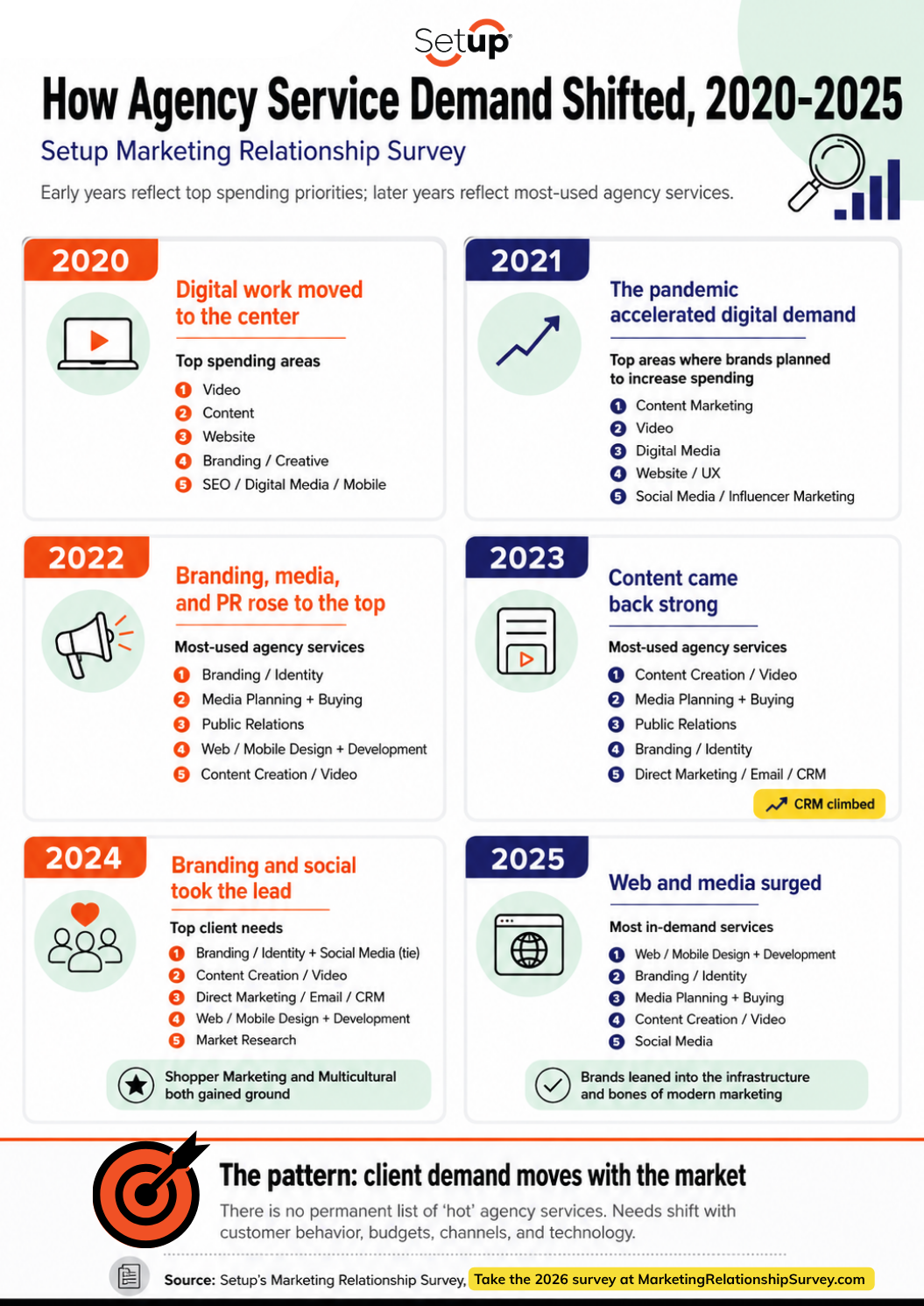
2020: Digital Work Was Already Moving to the Center
In the 2019–2020 survey, Setup looked at clients' largest areas of marketing spending rather than asking the exact agency-service question used in later surveys.
The top spending areas were:
Video
Content
Website
Branding/Creative
SEO
Digital Media
Mobile
At the bottom were Traditional Media, Multicultural, traditional production, Emerging Tech, PR, Market Research, and Experiential.
Even before the full effects of the pandemic were clear, digital-oriented work was already taking a larger role in the marketing mix.
Video, content, websites, search, and digital media represented a substantial share of where marketers were investing. Those priorities would accelerate dramatically in the year ahead.
2021: The Pandemic Accelerated Digital Demand
By 2021, the impact of COVID on marketing priorities was unmistakable.
Setup found that the top five areas where brands planned to increase marketing spending by 50% or more were all digital:
Content marketing
Video
Digital media
Website/UX
Social media/influencer marketing
The digital shift created a particularly strong position for agencies specializing in those areas. Brands were rapidly adapting to new customer behaviors, digital interactions had become essential, and many organizations were compressing planning cycles so they could respond more quickly to changing conditions.
Digital became the primary way customers interacted with brands.
2022: Branding, Media and PR Rise to the Top
In 2022, Setup asked clients more directly what kinds of agencies they were working with most frequently.
The top five were:
Branding/Identity
Media Planning + Buying
Public Relations
Web/Mobile Design + Development
Content Creation/Video
The results showed a shift from the height of the pandemic.
Content Creation/Video dropped significantly compared to 2021, although it remained among the top five services. Meanwhile, Multicultural marketing increased noticeably. The 2022 results also pointed toward clients reconsidering how many agency partners they wanted involved.
Brands were reconsidering what work they needed agencies to handle and how many partners they wanted involved.
2023: Content Comes Back Strong
A year later, the pendulum moved again.
Content Creation/Video became the most-used agency service in 2023, increasing from 43% of clients in 2022 to 58% in 2023.
Branding/Identity moved in the other direction, declining slightly from 54% to 48%.
Direct Marketing/Email/CRM increased by 8 percentage points, while Setup found that Media Planning, Social Media, and Content Creation had returned closer to their 2020 levels after dipping in 2022.
The ranked list started with:
Content Creation/Video
Media Planning + Buying
Public Relations
Branding/Identity
Direct Marketing/Email/CRM
One possible driver was the rise of short-form video across platforms like Instagram, TikTok, and YouTube, while brands faced constant pressure to feed more channels with more material.
The rise in CRM also suggests greater attention to managing and deepening relationships with existing customers.
2024: Branding and Social Take the Lead
The 2024 results shifted again as more than half of clients said they needed Branding/Identity and/or Social Media help from agency partners, putting those services at the top of the list.
The overall ranking was:
Branding/Identity + Social Media
Content Creation/Video
Direct Marketing/Email/CRM
Web/Mobile Design + Development
Market Research
Media Planning + Buying
Public Relations
Traditional Marketing
Experiential
Shopper Marketing
Multicultural
Several shifts stand out.
Content Creation/Video fell by 12 percentage points, although it still ranked high among client needs. PR experienced an even larger change, dropping from roughly 50% of clients in 2023 to 27% in 2024.
At the same time, two historically smaller areas started gaining ground.
Shopper Marketing increased from 5% to 15%.
Multicultural Marketing increased from 5% to 12%.
Neither suddenly became the dominant agency service needed, but the direction is notable.
These shifts show why agencies should be careful about dismissing a service simply because it sits near the bottom of the list.
2025: Websites and Media Surge
The most in-demand services reported in the 2025 survey were:
Web/Mobile Design + Development
Branding/Identity
Media Planning + Buying
Content Creation/Video
Social Media
Direct Marketing/Email/CRM
Public Relations
Market Research
Experiential
Traditional Marketing
Shopper Marketing
Multicultural
Web/Mobile Design + Development increased 20% compared with 2024, while Media Planning + Buying increased 24%.
Media Planning + Buying increased 24%.
After several years when content and social dominated much of the conversation, brands were again investing heavily in the infrastructure supporting their marketing. Websites, platforms, performance channels, lifecycle marketing, CRM, and media were all becoming more important.
The 2025 report described this as brands leaning further into the “infrastructure and bones of modern marketing.” Brands still needed ideas, storytelling, and creative production, but they also needed partners who could help the broader marketing system perform.
The Long-Term Pattern Is Not That One Service Keeps Winning
It would be easy to look at the latest rankings and conclude:
Web development is hot. Agencies should sell web development.
That is not the case, however, because the bigger takeaway is that client demand moves.
Look at how the priorities have shifted:
2020: Video, content and websites dominated spending.
2021: Digital services accelerated dramatically.
2022: Branding, media and PR led agency demand.
2023: Content Creation/Video surged back to number one.
2024: Branding and Social Media moved to the top.
2025: Web/Mobile and Media Planning experienced major increases.
There is no static agency-services hierarchy.
For Brands: Start With the Need, Not the Agency
The shifting data reinforces something Setup sees regularly in agency searches. The right agency structure depends on what the business actually needs right now.
A company that needs a brand transformation may need a very different partner than one rebuilding its marketing technology stack. The service need should help determine the agency model, not the other way around.
That becomes even more important as marketers reconsider generalists versus specialists.
In the 2025 survey, only 26% of clients agreed that generalist agencies were better than specialists, a 29% decline from the previous year. And 70% disagreed that working with one generalist made more sense than using several specialist agencies.
That is a major shift from 2022, when clients were expressing more interest in consolidating capabilities with fewer partners. Client needs evolve, and agency models have to evolve with them.
For Agencies: Don't Chase Every Trend
Agencies should not look at the list and jump on the most popular service. Trying to be everything to everyone creates its own problems. Instead, agencies should understand where their genuine strengths overlap with growing client demand.
Adding a service simply because buyers appear interested will not create a strong agency. Clients ultimately experience the quality of the delivery. Setup's broader Marketing Relationship Survey findings have repeatedly shown how quickly relationships can deteriorate when what an agency promises outpaces what it can execute.
What Will Brands Need Next?
Determining what marketers should do next is why Setup conducts this research. Technology changes. Consumer behavior and preferences change. Budgets change. What marketers needed from agencies in 2020 was shaped by a very different environment than what they needed in 2025.
AI is now changing both how marketing gets produced and what brands may need from outside partners. The 2026 Marketing Relationship Survey will give us another data point in that evolution.
For the eighth year, Setup is asking marketers on both sides of the relationship where they need support, what's working, what's changing, and what they expect from their partners next. In partnership with The CMO Institute, the 2026 survey will examine the agency capabilities clients need alongside the broader state of brand-agency collaboration.
Knowing what marketers needed five years ago is interesting. Knowing what they need now is what helps brands and agencies make better decisions.
Take the 2026 Marketing Relationship Survey and help us understand where brand-agency needs are headed next.